
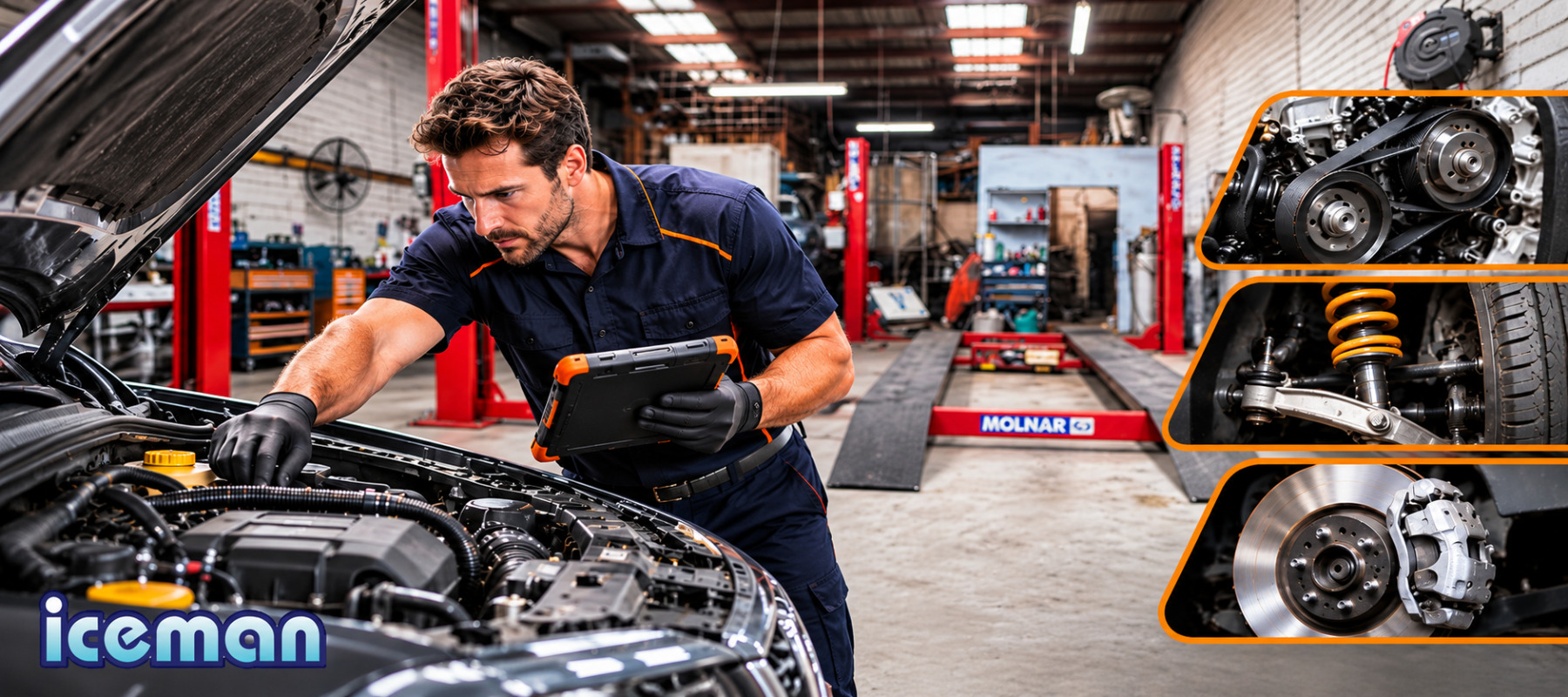
If your car is making strange noises — knocking over bumps, clunking when you turn or squeaking as you brake — the timing of those sounds can provide valuable clues about what’s wrong. A knocking noise when driving over bumps may point to worn suspension bushes, ball joints or loose components beneath the vehicle. A clunking noise when turning could involve steering, suspension or driveline components, depending on exactly when it occurs. And a squeaking noise when braking deserves attention too, particularly if the sound persists or your car feels different when slowing down. In this guide, we’ll explain why a car can make strange noises, what the different sounds might indicate and when it’s time to arrange a professional mechanical inspection.
When Does Your Car Make the Noise?
Before trying to identify a mechanical fault, pay attention to exactly when the noise occurs. A clunk while crossing a speed bump may have a completely different cause from a knocking sound that appears when accelerating uphill. The conditions under which the noise develops can help narrow down which components need investigating.
- Over bumps or uneven roads: Suspension bushes, shock absorber mounts, sway-bar links or loose underbody components may be responsible.
- When turning: Steering linkages, suspension joints, strut mounts or CV joints could be involved.
- When braking: Brake pads, discs, calipers or other braking components deserve attention.
- At highway speeds: Tyres, wheel bearings, wheel balance and drivetrain components are worth investigating.
- When accelerating or changing gears: Engine mounts, transmission mounts, driveshafts or internal engine problems may need checking.
These are starting points rather than definite diagnoses. The same sound can come from different components, and a problem that initially seems minor can sometimes involve an important safety-related part. The NRMA’s guide to unusual car noises also explains why where and when a sound occurs matters.
Why Does My Car Make a Clunking Noise Over Bumps?
A clunking noise when driving over potholes, speed bumps or uneven roads is frequently associated with movement in the suspension. Springs, shock absorbers, bushes and connecting joints work together to absorb road irregularities while helping the tyres maintain contact with the road. As components wear, excessive movement can develop, sometimes causing an audible knock or clunk.
- Suspension bushes: Worn or deteriorated bushes can allow unwanted movement between suspension components.
- Sway-bar links: Loose or worn links may produce repetitive knocking on uneven surfaces.
- Ball joints: Excessive wear may cause noise and can become a serious steering or suspension safety concern.
- Shock absorber mounts: Deteriorated mountings can clunk as the suspension compresses and extends.
Not every clunk indicates suspension failure: a loose exhaust mounting, damaged underbody panel or unsecured component can make a similar sound. The important point is that hearing a clunk doesn’t automatically mean the shock absorbers need replacing. Finding the actual source of the movement helps prevent unnecessary repairs.
Why Does My Car Squeak When Turning?
A squeaking noise when turning can originate from several steering and suspension components. Suspension bushes may creak as they flex, while strut-top mounts or bearings can make noise when the steering wheel turns, particularly during parking manoeuvres. On vehicles with hydraulic power steering, problems with the pump or fluid system can also produce whining or groaning.
It’s worth distinguishing a squeak from repetitive clicking. A clicking sound when accelerating around a tight corner, particularly in a front-wheel-drive or all-wheel-drive vehicle, can indicate a worn outer CV joint. These joints transfer power through the driveshaft while accommodating steering and suspension movement; a damaged protective boot can let grease escape and dirt enter, accelerating wear.
Iceman’s drivetrain repair services include CV joints, driveshafts and related components. Because steering, suspension and drivetrain systems work together, a proper inspection may need to consider several possible sources before identifying the fault.
Squealing or Grinding When Braking — What Could Be Wrong?
Brake noises deserve particular attention because the braking system directly affects your ability to slow down and stop safely. A brief squeak is not always evidence of serious trouble: moisture, light surface rust or some brake-pad materials can cause temporary noise. Persistent squealing, scraping or grinding, however, should not be dismissed.
Some pads have wear indicators that make a high-pitched sound when the friction material is nearing replacement. If pads wear excessively, metal components can begin contacting the discs, potentially damaging them. A sticking caliper, damaged disc, loose hardware or debris near the brakes can also produce unwanted sounds.
Pay attention to how the brakes feel as well. Vibration through the steering wheel, pedal pulsation or an unusually soft pedal warrants inspection. RACV’s brake-safety guidance recommends prompt attention to unusual braking noises, vibrations and changes in performance.
At Iceman, brake inspections and repairs cover pads, discs, calipers and associated components. If braking performance has deteriorated, the pedal feels unsafe or severe grinding develops, stop safely and arrange professional or roadside assistance rather than continuing to drive.
Why Is My Car Humming or Vibrating at Highway Speeds?
Some mechanical problems only become noticeable once a vehicle reaches a particular road speed. Humming, rumbling or growling that increases as you drive faster can indicate wheel-bearing wear, although tyres and other rotating components can produce similar sounds. Worn bearings may also change pitch or intensity as cornering loads shift.
Uneven tyre wear can generate a pronounced road hum. Vibration through the steering wheel might instead involve an unbalanced wheel, damaged tyre, bent rim or a steering or suspension fault. And if the vibration changes with acceleration or deceleration, the driveline may need attention too.
Wheel balancing and wheel alignment are not the same procedure. Balancing corrects uneven weight distribution in a rotating wheel-and-tyre assembly, while alignment concerns wheel geometry. Transport Victoria explains why tyre condition and maintenance are essential for vehicle handling and road safety. Finding the actual cause of a hum or vibration helps avoid replacing the wrong components.
Why Is My Engine Making a Knocking or Rattling Noise?
Not every knocking noise comes from beneath the vehicle; some sounds originate inside the engine or from accessories attached to it. One useful distinction is whether the sound follows engine speed rather than road speed. If a rattle becomes faster as you rev the engine while stationary, an engine-driven component may be involved.
Possible causes include loose accessories, worn belt tensioners, timing-chain or tensioner problems and internal engine wear. Petrol engines can also experience combustion knock or pinging under load, which differs from a deep mechanical knock associated with internal damage. These possible faults vary greatly in seriousness and cannot reliably be distinguished from sound alone.
A new, pronounced knocking sound accompanied by an oil-pressure warning, loss of power or other serious symptoms requires immediate attention. RACV’s dashboard warning-light guide explains the danger of low oil pressure. If an oil-pressure warning illuminates while driving, stop safely and switch off the engine rather than continuing to drive.
Iceman’s engine repair and diagnostic services cover internal engine noises, oil leaks and other mechanical faults. Investigation may involve inspecting external components, checking lubrication or performing more detailed engine tests.
Could Potholes and Poor Victorian Roads Be Causing the Noise?
If your car started knocking, squeaking or vibrating after striking a pothole, that impact may be relevant to the problem. Victoria’s road conditions have attracted considerable scrutiny, including ABC News reporting published on 17 September 2026 based on the Victorian Auditor-General’s findings.
The Victorian Auditor-General’s Maintaining State Roads report found that the proportion of state-managed roads classified as poor or very poor increased from approximately 39% in 2021 to 48% in 2024. These figures concern state-managed roads, not every road in Victoria.
A substantial pothole impact can damage more than a tyre. Wheels, suspension arms, shock absorbers, steering components and underbody parts can also be affected, sometimes without immediately visible damage. You may first notice a steering wheel that no longer sits straight, the car pulling to one side, increased vibration or a new clunk over bumps.
RACV’s advice on pothole damage explains why changes in handling after an impact should be investigated. If you experienced a significant road impact before the noise began, mention it when arranging a mechanical inspection.
Is It Safe to Keep Driving When Your Car Makes Strange Noises?
Not every unfamiliar sound means your car is unsafe to drive, but it is a mistake to assume a noise is harmless simply because the vehicle still moves normally. Some faults develop gradually; others can affect steering, braking or vehicle control more suddenly.
The following signs call for immediate attention and may require you to stop driving and arrange roadside assistance:
- Severe grinding, banging or knocking accompanied by a change in steering or handling.
- Steering that suddenly feels loose, unstable or difficult to control.
- Reduced braking performance, an unsafe-feeling brake pedal or serious brake warnings.
- Pronounced wheel wobble, significant tyre damage or a rapidly deflating tyre.
- Heavy engine knocking with an oil-pressure warning, smoke or substantial loss of power.
If vehicle control may be compromised, find a safe place to stop and seek help rather than attempting to drive to a workshop. Transport Victoria’s roadworthy guidance recognises steering, suspension, brakes, wheels and tyres as critical vehicle-safety areas. Even when a noise seems less urgent, an unexplained change is worth checking before a long journey.
How Does a Mechanic Diagnose Knocking, Clunking or Squeaking Noises?
Accurate diagnosis starts with understanding the circumstances in which the noise occurs. A mechanic may ask whether it happens when the engine is cold, while braking, under acceleration, on rough roads or only at particular speeds.
Depending on the symptoms, investigation might include a controlled road test, tyre and wheel examination, inspection on a hoist or checking steering and suspension components for excessive movement. Brake, engine and driveline components may also need attention. Electronic diagnostic equipment can be valuable for certain engine-management and electronically controlled system faults, but not every mechanical problem generates a fault code.
That’s why replacing a component simply because it might be responsible isn’t always sensible. Iceman’s general mechanical servicing and fault-diagnosis work includes investigating persistent engine, drivetrain and undercarriage noises. The aim is to identify the cause, explain the findings and recommend appropriate repairs without unnecessary guesswork.
What Should You Tell Your Mechanic About the Noise?
You don’t need to know what is mechanically wrong before seeking help. The more accurately you describe the circumstances, however, the easier it may be to decide where to begin investigating. Make a note of when the noise first appeared and whether braking, accelerating, turning or driving on rough roads changes it.
Also mention recent pothole strikes, prior repairs or any change in handling. A short audio or video recording of an intermittent sound can be helpful, provided it is captured safely without distracting the driver. Never attempt high-speed manoeuvres or unsafe tests simply to reproduce a fault; an appropriate inspection or controlled test drive is the mechanic’s job.
Frequently Asked Questions About Strange Car Noises
Why does my car knock when I drive over speed bumps?
A knocking sound over speed bumps may indicate worn suspension bushes, sway-bar links, ball joints or shock absorber mountings. Loose exhaust or underbody components can produce similar sounds. An inspection is needed to identify the source and determine whether a safety-related component is affected.
Why does my car squeak when I turn the steering wheel?
Possible causes include worn suspension bushes, strut-top mounts, steering joints or hydraulic power-steering components. The likely cause depends on the vehicle and whether the sound occurs while stationary or moving. Persistent squeaking should be investigated, particularly if steering performance has changed.
Can a bad wheel bearing make a humming noise?
Yes. A worn wheel bearing can produce humming, growling or rumbling that becomes more noticeable as road speed increases. However, tyre wear and other rotating components can create similar noises, so the source needs to be confirmed before replacement.
Why does my car vibrate when I press the brakes?
Vibration under braking may involve brake-disc condition, uneven friction deposits, caliper problems or other braking-system faults. Worn steering and suspension components may contribute to what you feel through the steering wheel. A proper inspection should establish the cause before parts are replaced.
Why does my engine knock when I accelerate?
Knocking under acceleration may involve combustion knock, engine mounts, drivetrain components or internal engine problems. The character of the noise and whether it follows engine speed help narrow down the possibilities. Pronounced knocking with warning lights or loss of power requires urgent attention.
Can I keep driving with a clunking suspension?
That depends on which component is causing the noise. Some faults may be relatively minor, while significant wear in a ball joint or another safety-critical part can be dangerous. Arrange an inspection promptly, and stop driving if steering, braking or handling becomes unstable.
Don’t Let an Unfamiliar Noise Become Your Car’s New Normal
It’s surprisingly easy to get used to a squeak, clunk or rattle, particularly when it develops gradually. But a noise you’ve been hearing for weeks isn’t necessarily harmless, and waiting until it gets louder isn’t a reliable way to judge how serious the problem might be.
The best starting point is understanding when the sound occurs, which mechanical systems may be involved and whether the vehicle shows other symptoms. If your car is making unfamiliar noises, our mechanics in Croydon can investigate steering, suspension, braking, drivetrain and engine problems. We’ll explain what we find and recommend the work that’s actually needed, so you can make an informed decision.
Got a knocking, clunking or squeaking noise you can’t identify? Contact Iceman Radiators to arrange a mechanical inspection.