
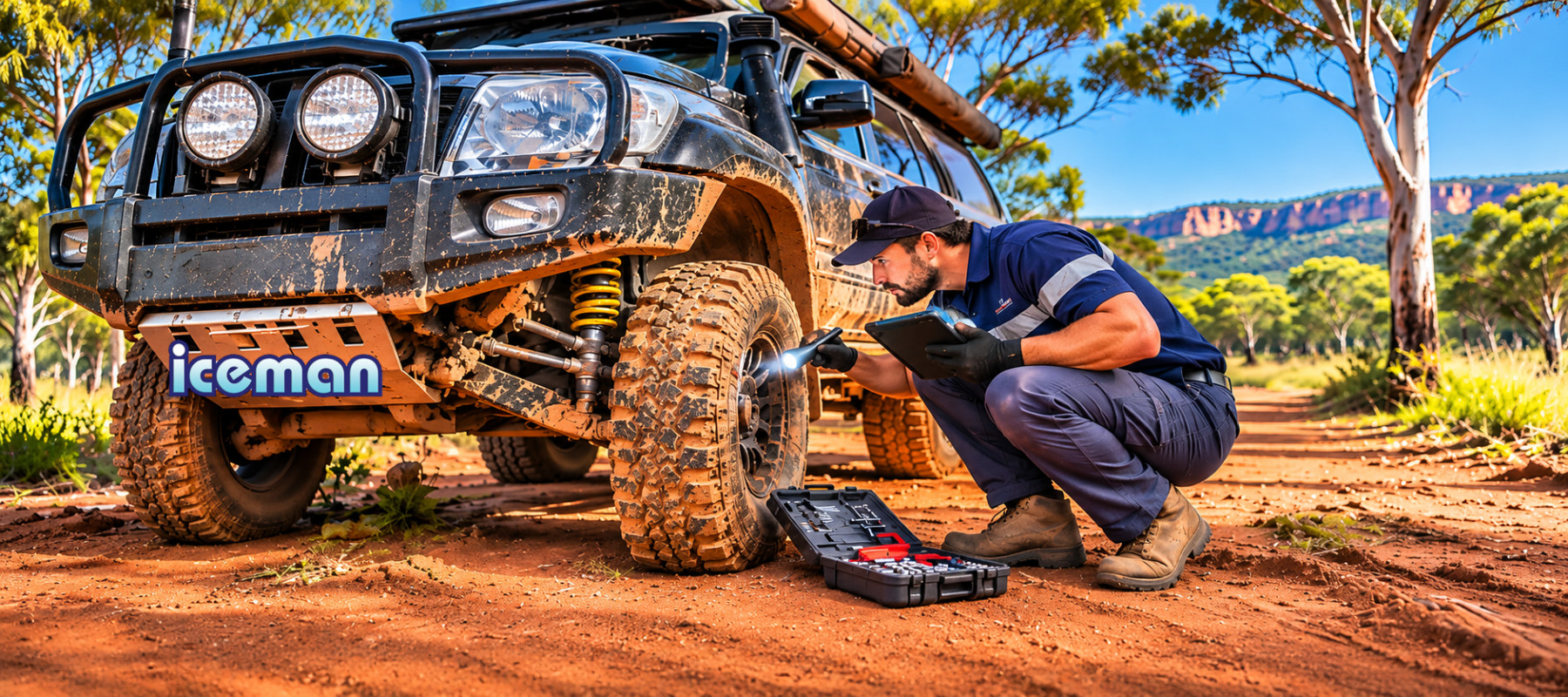
4WD maintenance becomes particularly important when your vehicle regularly tackles rough tracks, corrugations, mud, sand, steep climbs or water crossings. Unlike normal highway driving, off-road vehicle maintenance needs to account for repeated impacts, greater suspension movement, increased drivetrain loads and exposure to dust and water. Even a well-maintained 4×4 can develop accelerated wear when components are subjected to these conditions over extended periods. A damaged suspension bush, contaminated differential oil or misaligned wheel might not cause an immediate breakdown, but each can lead to more serious mechanical problems if left unattended. In this guide, we’ll explain which areas deserve extra attention during 4WD servicing, how seemingly minor faults can affect other components and why a thorough post-trip inspection can save considerable trouble later.
Why Does Off-Road Driving Change Your 4WD’s Maintenance Requirements?
A 4WD travelling along a sealed highway operates under very different conditions from one negotiating deep ruts, steep rocky tracks or kilometres of corrugated gravel roads.
On smooth roads, suspension movement is generally more predictable. Off-road, the wheels may be travelling through much greater suspension angles, repeatedly compressing and extending over uneven ground. At the same time, drivetrain components can experience sudden changes in load as tyres gain and lose traction.
There are also environmental factors to consider. Dust can enter air filters and work its way past damaged seals. Water and mud can contaminate lubricants, while rocks and ruts can damage components underneath the vehicle.
Some of the conditions that place additional demands on a 4WD include:
- Corrugated roads: Repeated vibration and suspension movement can accelerate wear in bushes, shock absorbers, mountings and fasteners.
- Rocky tracks and deep ruts: Sudden impacts can damage steering, suspension, tyres, wheels and underbody components.
- Mud and water: Moisture and contamination can affect bearings, brakes, electrical connections and drivetrain lubricants.
- Steep climbs and low-range driving: Higher drivetrain loads and reduced vehicle speed can increase demands on cooling and transmission systems.
- Heavy touring loads: Additional passengers, accessories, camping equipment and towing loads place greater demands on suspension, brakes and tyres.
Not every off-road journey creates significant damage. However, the harder the vehicle has been working, the more important it becomes to assess its condition afterwards.
Even vehicle manufacturers recognise that severe operating conditions may require more frequent servicing than normal road use. The appropriate schedule depends on the vehicle, its usage and the manufacturer’s recommendations.
Suspension and Shock Absorbers — More Than Just Ride Comfort
Your 4WD’s suspension works particularly hard off-road.
Springs support the vehicle’s weight, while shock absorbers control suspension movement. Bushes, ball joints, control arms and mounting points allow the wheels to move while maintaining steering and suspension geometry.
On corrugated tracks, shock absorbers may cycle repeatedly over long distances. This generates heat within the dampers and can expose weaknesses that aren’t particularly noticeable during ordinary suburban driving.
Meanwhile, deteriorated suspension bushes can permit unwanted movement between components, while worn shock absorber mountings may produce knocking or looseness.
Here’s where one problem can begin affecting another.
A worn suspension bush may allow a control arm to move beyond its intended range. Depending on the suspension design and the extent of wear, that movement can alter wheel geometry under load, contribute to unstable handling and accelerate tyre wear.
Similarly, a shock absorber that’s no longer controlling wheel movement properly may allow excessive bouncing, reducing the tyre’s ability to maintain consistent contact with uneven ground.
When we’re inspecting a 4WD that’s been working hard off-road, we look beyond whether the suspension is simply still functioning. We’ll examine bushes, mounts, springs, shock absorbers and associated components for signs of impact damage, leaks, deterioration or excessive movement.
The aim is to identify developing wear before it begins affecting the vehicle’s handling, tyre life or other suspension components.
Steering, Wheel Alignment and Tyre Wear — How Problems Compound
Wheel alignment deserves particular attention after demanding off-road driving.
A heavy impact with a rock, rut or deep pothole can damage a steering or suspension component, or alter the vehicle’s wheel alignment.
Even when there’s no immediately obvious damage, the consequences can become apparent over time.
For example, incorrect toe alignment can cause a tyre to scrub across the road surface rather than roll in its intended direction. This can produce feathered or uneven tread wear, sometimes reducing tyre life considerably.
Excessive camber or changes in suspension geometry may also contribute to wear concentrated along the inner or outer edges of a tyre.
The relationship can become a chain reaction:
A hard impact damages or shifts a component → wheel alignment changes → tyres develop irregular wear → handling deteriorates and tyres may require premature replacement.
RACV’s guide to potholes and vehicle damage explains how road impacts can damage steering and suspension components, affect alignment and contribute to uneven tyre wear.
For 4WD owners, there’s another consideration: tyres are often expensive, particularly larger all-terrain and mud-terrain tyres.
Correct tyre pressures are also important. Pressures may be adjusted for suitable off-road conditions, but they need to be restored to the manufacturer’s appropriate road-use settings before normal highway travel resumes.
If you notice your steering wheel is no longer centred, your vehicle begins pulling to one side or the tyres are wearing unevenly, we’ll investigate steering and suspension condition before assuming a simple alignment adjustment is all that’s needed.
There’s little value in correcting wheel alignment if a damaged or worn mechanical component is allowing the geometry to change again.
Wheel Bearings, Hubs and Axle Seals — Hidden Wear After Water and Mud
Wheel bearings support substantial loads while allowing your wheels to rotate smoothly.
In off-road conditions, these components may be exposed to heavy impacts, repeated vibration and, depending on the vehicle’s design, the possibility of contamination through damaged seals.
Mud, sand and water are particularly troublesome when they enter areas designed to retain clean lubricant.
Contaminated grease may lose some of its protective properties. Grit can accelerate wear, while water can contribute to corrosion of bearing surfaces.
The effects aren’t necessarily immediate.
A wheel bearing might continue operating after exposure to water, only to develop humming, rumbling, looseness or excessive heat as wear progresses.
Damaged axle seals can create similar concerns by allowing lubricant to escape or contaminants to enter nearby mechanical assemblies.
When inspecting a 4WD that’s been through particularly wet or muddy conditions, we’ll pay close attention to the condition of accessible seals, hubs and bearings, along with any evidence of lubricant leakage or excessive play.
A bearing that’s beginning to deteriorate deserves attention before it develops into a more serious reliability or safety issue.
CV Joints, Driveshafts and Differentials — The Drivetrain Works Harder Off-Road
Your 4WD’s drivetrain transfers engine torque through the transmission, transfer case, driveshafts, differentials and axle assemblies to the wheels.
Off-road, that transfer of power isn’t always smooth.
One wheel may briefly lose traction before gripping again, while steep climbs, low-range operation and difficult terrain can place substantial loads on drivetrain components.
Protective components such as CV-joint boots are particularly important.
A split CV boot can allow grease to escape while admitting dirt and water. Once contamination reaches the joint, the resulting wear can progress considerably faster.
That means a relatively inexpensive damaged protective boot, if detected promptly, may prevent a much more expensive joint repair. Whether the joint can be retained depends on its condition.
Differentials and transfer cases also deserve additional attention after prolonged water exposure.
Water entering through a damaged seal or breather can contaminate lubricant, compromising its ability to protect gears and bearings.
The Australian Government’s 4WD operating competency guidance includes post-water-crossing inspections and recognises the importance of checking vehicles for damage after operating in difficult terrain.
Depending on the conditions and vehicle design, we may recommend inspecting differential, gearbox or transfer-case lubricants for contamination, alongside checking seals, breather arrangements and driveline components.
Our drivetrain repair services cover differentials, driveshafts, universal joints and CV joints, allowing us to investigate wear and mechanical problems before they become more extensive.
The important thing to remember is that contaminated lubricant can begin causing damage long before a differential or gearbox becomes noticeably noisy.
Engine and Transmission Cooling — Low Speed Doesn’t Mean Low Stress
It’s tempting to assume that a vehicle travelling slowly isn’t working particularly hard.
Off-road driving can prove otherwise.
Climbing steep terrain, negotiating sand or travelling in low range can place considerable demands on the engine and drivetrain even when road speed is relatively low.
At low speeds, there’s also less natural airflow passing through the radiator and other heat exchangers.
The engine cooling system must therefore rely more heavily on correct coolant circulation, radiator condition and cooling-fan performance.
Mud, leaves and accumulated debris can create additional problems by restricting airflow through radiator and condenser fins.
Some vehicles are also equipped with transmission coolers, which become particularly important under heavy loads or demanding operating conditions.
A cooling system that’s adequate during normal commuting may struggle if airflow becomes restricted or a component is already deteriorating.
We’ll assess coolant condition, radiator airflow, hoses, fans and associated cooling components where the vehicle’s operating history suggests they’ve been working particularly hard.
Our radiator and cooling-system services cover these areas, along with the diagnosis of leaks and overheating problems.
The benefit of inspecting the system after demanding use is that we have an opportunity to identify restrictions, damage or developing faults before the next long-distance journey.
Brakes and Hydraulic Components — Mud, Water and Steep Descents
Off-road conditions can be particularly demanding on brakes.
Long descents may require careful speed control, while water and mud can temporarily affect braking performance or introduce contamination around brake components.
Sand, grit and stones can become trapped around brake assemblies. Damaged protective components may also expose parts to more contamination than intended.
Brake hoses and rigid brake pipes underneath the vehicle can be vulnerable to impacts, particularly where a 4WD has crossed rocks or deep ruts.
After driving through mud or water, brake performance should be checked in a safe, controlled manner in accordance with the vehicle manufacturer’s guidance.
The Australian Government’s 4WD operating standards include checking and drying brakes following water crossings, reflecting the importance of verifying braking performance after these conditions.
When inspecting a vehicle that’s been subjected to demanding off-road use, we’ll examine relevant braking components for excessive wear, impact damage, contamination and hydraulic leaks.
Our brake inspection and repair services include pads, discs, calipers and associated hydraulic components.
If braking performance has changed, the pedal feels abnormal or a brake warning appears, don’t assume the system will return to normal after a few kilometres. Seek appropriate professional attention before continuing a journey where braking safety may be compromised.
Exhaust System and Underbody Damage — More Than Just an Unusual Noise
A 4WD’s exhaust system can be vulnerable to damage from rocks, deep ruts, fallen branches and unexpected underbody impacts.
Exhaust pipes, flexible sections, mountings and joints can be bent, cracked or loosened by contact with obstacles.
While the resulting exhaust noise may be the first obvious symptom, the mechanical consequences can be more significant.
For example, a leak in the exhaust system upstream of an oxygen sensor can affect the accuracy of the sensor’s readings on some petrol engines.
Under certain operating conditions, outside air can enter through the leak, causing the sensor to report a leaner exhaust mixture than is actually being produced by combustion.
The engine-management system may then alter fuel delivery in response to misleading information.
There’s also an important distinction between an exhaust leak and an exhaust restriction.
A damaged or crushed exhaust pipe may restrict gas flow, increasing exhaust backpressure under sufficient engine load and potentially reducing performance. An ordinary exhaust leak doesn’t automatically increase backpressure.
These are different faults, and they require different diagnostic approaches.
Independent automotive technical publication MOTOR explains how exhaust leaks can affect oxygen-sensor readings and fuel control.
There’s also the safety concern of exhaust gases entering the passenger compartment, particularly if the system is damaged near the front of the vehicle.
When assessing underbody damage, we’ll look for impact marks, damaged mountings, leaks, crushed pipework and other components that may have been affected.
If you notice a sudden change in exhaust noise, fumes entering the cabin or an unexplained loss of engine performance after an off-road impact, have the vehicle inspected promptly. If exhaust fumes are entering the cabin, stop safely and don’t continue driving.
Air Filters, Electrical Connections and Underbody Protection
Dust and water can create problems that aren’t always immediately obvious.
Driving in convoy along dusty tracks can expose your engine’s air filter to significantly more airborne contamination than normal suburban conditions.
A heavily restricted air filter can affect engine airflow and performance, while damage to an air-filter housing or intake seal may allow abrasive dust to bypass the filter.
That’s a particularly serious concern because dust entering an engine can accelerate internal wear.
Electrical connections deserve attention too.
Moisture, mud and damaged insulation can affect sensors, wiring connectors and electrical components, especially where wiring runs underneath the vehicle or near exposed mechanical assemblies.
Underbody protection also needs checking. A loose bash plate, damaged mounting or bent guard can create rattles, interfere with nearby components or leave important mechanical parts exposed.
During an off-road inspection, we’ll consider air-intake condition, accessible electrical connections and underbody protection alongside the main mechanical systems.
These are the kinds of details that can be easy to overlook when a vehicle appears to be driving normally.
Should a 4WD Be Inspected More Critically After Off-Road Use?
I believe this is one of the most important differences between ordinary scheduled servicing and maintaining a vehicle regularly used off-road.
A component doesn’t have to be completely worn out before its condition becomes worth addressing.
A suspension bush showing early deterioration, a CV boot beginning to split or an axle seal showing signs of leakage may deserve closer scrutiny when the vehicle is regularly subjected to rough terrain, heavy loads and remote travel.
That’s not an argument for replacing perfectly serviceable components unnecessarily.
Rather, the condition of a part needs to be considered alongside the demands being placed on it.
A 4WD used almost exclusively around Melbourne may have a very different maintenance profile from one that spends weekends negotiating steep rocky tracks or travelling long distances on corrugated roads.
Vehicle load matters too. Bullbars, winches, canopies, storage systems, auxiliary batteries, camping equipment and passengers all contribute to vehicle weight.
Those loads need to be considered against the vehicle’s gross vehicle mass and axle-load limits, as well as its suspension, tyre and braking capabilities.
For vehicles used regularly in demanding conditions, we’ll review the manufacturer’s applicable servicing requirements, examine areas exposed to additional wear and explain which components deserve closer monitoring or attention.
This approach helps owners make informed decisions based on the vehicle’s actual operating conditions rather than relying solely on how many kilometres have passed since the last service.
What Should You Check After an Off-Road Trip?
You don’t need to be an experienced mechanic to notice some of the signs that your 4WD may need attention.
Once the vehicle has been safely parked and the relevant components have cooled, a straightforward visual inspection can reveal problems worth investigating.
Some useful checks include:
- Tyres and wheels: Look for cuts, bulges, uneven wear, damaged rims and changes in tyre pressure.
- Underbody: Check for obvious impact damage, hanging components, leaks or damaged protective guards without crawling beneath an unsupported vehicle.
- Steering and handling: Consider whether the vehicle now pulls to one side, vibrates or feels different from before the trip.
- Suspension: Listen for new knocking or squeaking noises and look for obvious damaged or leaking components.
- Cooling system: Check coolant levels when cold and look for visible damage or debris restricting airflow.
- Brakes: Pay attention to changes in braking performance, unusual noises or warning indicators.
These observations can help identify whether further inspection is needed. However, they don’t replace professional mechanical checks, particularly after water crossings, significant underbody impacts or prolonged operation in harsh conditions.
Don’t attempt to inspect inaccessible components underneath a vehicle without suitable lifting and support equipment.
Also remember that some contamination problems, particularly water entering a differential or gearbox, may not produce an immediately recognisable symptom.
If an engine has stalled in deep water or you suspect water has entered the intake, don’t attempt to restart it. Arrange professional assistance, as doing so can risk serious internal engine damage.
For anyone planning another demanding trip, our pre-trip vehicle safety inspections can also help identify problems before the vehicle returns to remote country.
Frequently Asked Questions About 4WD Maintenance
Does a 4WD need servicing more often if it’s driven off-road?
It may. Vehicles regularly used in dusty, muddy, wet or otherwise demanding conditions can require additional inspections and shorter servicing intervals for certain components. The appropriate schedule depends on the vehicle manufacturer’s severe-service recommendations, the type of driving and the condition of the vehicle.
Can off-road driving cause wheel alignment problems?
Yes. A hard impact with rocks, ruts or other obstacles can damage steering or suspension components and alter wheel geometry. Incorrect alignment can contribute to uneven tyre wear, steering pull and changes in handling. We recommend checking component condition before assuming wheel alignment adjustment alone will resolve the problem.
Should differential oil be checked after a water crossing?
Following significant or prolonged water exposure, checking the relevant drivetrain lubricants may be advisable, depending on the vehicle and conditions. Water can enter through damaged seals or breather arrangements and compromise lubrication. A differential may continue operating despite contamination, so the absence of unusual noise doesn’t necessarily mean the oil is unaffected.
Can corrugated roads damage shock absorbers?
Corrugated roads can place repeated demands on shock absorbers, suspension bushes and mounting points. Prolonged operation may generate considerable damper heat and expose worn or inadequate components. Leaking shock absorbers, unusual suspension noises or changes in vehicle control should be investigated.
Can a damaged exhaust affect engine performance?
Yes, depending on the type and location of the damage. A restricted or crushed exhaust can increase backpressure and reduce performance, while a leak upstream of an oxygen sensor may affect fuel-control readings on certain vehicles. Exhaust leaks may also create a safety concern if fumes enter the cabin.
Should I have my 4WD inspected even if nothing seems wrong?
That depends on how the vehicle has been used. After significant impacts, prolonged water exposure or particularly demanding off-road driving, an inspection can identify developing wear or contamination that isn’t immediately obvious from the driver’s seat. Regular maintenance should also reflect the manufacturer’s requirements for the vehicle’s actual operating conditions.
Look After Your 4WD Before Small Problems Become Bigger Ones
One of the important lessons from off-road vehicle maintenance is that mechanical problems don’t always develop in isolation.
A damaged suspension bush can contribute to unwanted movement and tyre wear. A split CV boot can allow contaminants into a joint. Water entering a differential can compromise lubrication, while a restricted radiator or damaged exhaust can affect engine performance.
Any one of these problems might begin with a relatively minor defect.
The value of a thorough inspection is identifying that problem before it causes further damage, affects the vehicle’s reliability or leaves you stranded somewhere remote.
At Iceman Radiators in Croydon, we’re full-service mechanics who work on everyday passenger cars, 4WDs, SUVs and light commercial vehicles. Our mechanical services extend across steering, suspension, brakes, drivetrains, cooling systems and electrical diagnostics.
When we’re inspecting a 4WD that’s been working hard off-road, we’ll consider both its mechanical condition and how it’s actually being used. We’ll explain what we find, identify areas that need attention and recommend appropriate repairs or maintenance based on those findings.
If your 4WD has been working hard off-road, contact Iceman Radiators to arrange a mechanical inspection. We’ll help you prepare it for the next trip, with fewer unwelcome surprises along the way.